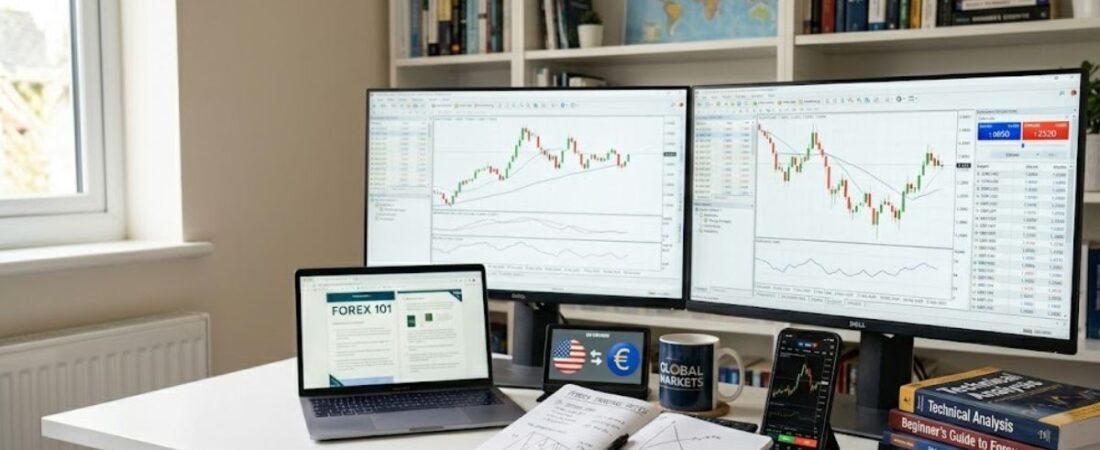
Forex trading has become one of the most popular ways to participate in global financial markets. Millions of traders around the world buy and sell currencies every day to profit from exchange rate fluctuations. However, many beginners find forex trading confusing because of its unique terminology and market structure.
This beginner’s guide will help you understand the basics of forex trading, how the forex market works, key trading concepts, benefits, risks, and practical tips to get started.
What Is Forex Trading?
Forex trading, also known as foreign exchange trading or currency trading, involves buying one currency while simultaneously selling another. The goal is to profit from changes in the exchange rates between currency pairs.
The forex market is the largest financial market in the world, with a daily trading volume exceeding trillions of dollars. Unlike stock markets, forex trading operates 24 hours a day, five days a week.
For example:
- Buying EUR/USD means purchasing Euros while selling US Dollars.
- If the Euro strengthens against the Dollar, the value of the pair rises.
- Traders can then sell at a higher price to make a profit.
How Does the Forex Market Work?
The forex market works through a global network of banks, financial institutions, brokers, corporations, and individual traders.
Unlike traditional stock exchanges, forex trading is conducted over-the-counter (OTC). This means transactions occur electronically through trading platforms rather than a centralized exchange.
Major Participants in the Forex Market
Central Banks
Central banks influence currency values through monetary policies, interest rates, and economic decisions.
Commercial Banks
Large banks facilitate currency transactions and contribute significantly to market liquidity.
Institutional Investors
Hedge funds, investment firms, and financial institutions trade currencies to manage portfolios and generate profits.
Retail Traders
Individual traders participate through online forex brokers using trading platforms.
Understanding Currency Pairs
Currencies are traded in pairs because you are exchanging one currency for another.
Major Currency Pairs
Major pairs involve the US Dollar and include:
- EUR/USD
- GBP/USD
- USD/JPY
- USD/CHF
- AUD/USD
- USD/CAD
These pairs usually offer high liquidity and tighter spreads.
Minor Currency Pairs
Minor pairs do not include the US Dollar but involve major global currencies.
Examples include:
- EUR/GBP
- EUR/AUD
- GBP/JPY
Exotic Currency Pairs
Exotic pairs include one major currency and one currency from an emerging economy.
Examples include:
- USD/TRY
- USD/ZAR
- EUR/SEK
These pairs typically have higher volatility and wider spreads.
Key Forex Trading Terminology
Understanding common forex terms is essential before placing trades.
Pip
A pip is the smallest price movement in a currency pair.
For most currency pairs:
- 1 pip = 0.0001
Lot Size
A lot represents the size of a forex trade.
Common lot sizes include:
- Standard Lot = 100,000 units
- Mini Lot = 10,000 units
- Micro Lot = 1,000 units
Spread
The spread is the difference between the buying price (Ask) and selling price (Bid).
A lower spread generally means lower trading costs.
Leverage
Leverage allows traders to control larger positions with a smaller amount of capital.
For example:
- 1:100 leverage means $100 controls a $10,000 position.
While leverage can increase profits, it can also magnify losses.
Margin
Margin is the amount of money required to open and maintain a leveraged position.
Why Do People Trade Forex?
Forex trading attracts traders for several reasons.
High Liquidity
The forex market is highly liquid, making it easy to enter and exit trades.
24-Hour Market Access
The market operates continuously during weekdays, allowing traders to participate from different time zones.
Low Capital Requirement
Many brokers allow traders to start with relatively small deposits.
Profit Opportunities in Rising and Falling Markets
Traders can profit whether a currency rises or falls by taking long or short positions.
Accessibility
Modern trading platforms make forex trading accessible from computers, tablets, and smartphones.
Types of Forex Trading Strategies
Different traders use different approaches based on their goals and experience.
Scalping
Scalpers make multiple trades throughout the day and aim to profit from small price movements.
Day Trading
Day traders open and close positions within the same trading day.
Swing Trading
Swing traders hold positions for several days or weeks to capture larger market movements.
Position Trading
Position traders maintain trades for months or even years based on long-term market trends.
Fundamental Analysis in Forex Trading
Fundamental analysis focuses on economic and political factors that affect currency values.
Interest Rates
Central bank interest rate decisions often have a major impact on currency prices.
Inflation
Higher inflation can reduce a currency’s purchasing power and affect its value.
Employment Data
Strong employment reports may strengthen a country’s currency.
Economic Growth
GDP growth often influences investor confidence and currency demand.
Political Stability
Stable governments generally attract investors, supporting currency strength.
Technical Analysis in Forex Trading
Technical analysis uses price charts and indicators to predict future market movements.
Support and Resistance
Support is a price level where buying interest tends to increase.
Resistance is a price level where selling pressure often appears.
Trend Analysis
Traders identify whether the market is moving:
- Upward
- Downward
- Sideways
Popular Technical Indicators
Common indicators include:
- Moving Averages
- Relative Strength Index (RSI)
- MACD
- Bollinger Bands
- Fibonacci Retracement
Technical analysis helps traders identify entry and exit opportunities.
Risk Management in Forex Trading
Successful traders focus on risk management as much as profit generation.
Use Stop-Loss Orders
A stop-loss automatically closes a trade when losses reach a predetermined level.
Manage Position Sizes
Avoid risking too much capital on a single trade.
Avoid Overleveraging
Excessive leverage can quickly wipe out trading accounts.
Follow a Trading Plan
A structured plan helps eliminate emotional decision-making.
Maintain Risk-to-Reward Ratios
Many professional traders aim for a minimum risk-to-reward ratio of 1:2 or higher.
Common Forex Trading Mistakes Beginners Make
New traders often make avoidable mistakes.
Trading Without Education
Entering the market without understanding basic concepts increases risk.
Ignoring Risk Management
Many beginners focus solely on profits and neglect risk control.
Overtrading
Taking too many trades can lead to unnecessary losses.
Emotional Trading
Fear and greed often result in poor decisions.
Chasing Losses
Trying to recover losses immediately can worsen trading performance.
How to Start Forex Trading
Getting started in forex trading involves several simple steps.
Choose a Reliable Forex Broker
Select a regulated broker with a strong reputation and competitive trading conditions.
Open a Demo Account
Practice trading with virtual money before risking real funds.
Learn Market Analysis
Develop skills in both fundamental and technical analysis.
Create a Trading Strategy
Build a strategy that suits your goals and risk tolerance.
Start Small
Begin with small position sizes while gaining experience.
Keep a Trading Journal
Track trades and analyze performance to improve decision-making.
Is Forex Trading Suitable for Beginners?
Forex trading can be suitable for beginners if approached with proper education, discipline, and risk management. While the market offers significant opportunities, it also carries substantial risks.
Successful forex traders understand that consistent learning and patience are essential. Rather than focusing on quick profits, beginners should prioritize developing skills and protecting their capital.
Conclusion
Forex trading is one of the world’s largest and most dynamic financial markets. It provides opportunities to profit from currency price movements, but it also requires knowledge, discipline, and effective risk management.
For beginners, the best approach is to start with education, practice using demo accounts, and gradually build trading experience. Understanding currency pairs, market analysis, and risk management principles can help create a strong foundation for long-term success in forex trading.
Frequently Asked Questions (FAQs)
What is forex trading in simple terms?
Forex trading is the process of buying one currency and selling another to profit from changes in exchange rates.
How much money do I need to start forex trading?
Many brokers allow traders to start with as little as $10 to $100, although larger capital provides better risk management flexibility.
Is forex trading risky?
Yes, forex trading involves significant risk. Proper risk management and education are essential to minimize potential losses.
Can beginners make money in forex trading?
Yes, beginners can make money, but success requires learning, practice, patience, and disciplined trading strategies.
What is the best currency pair for beginners?
EUR/USD is often recommended for beginners because it has high liquidity, lower spreads, and abundant educational resources.
Is forex trading legal?
Forex trading is legal in many countries, but regulations vary by jurisdiction. Traders should always use regulated brokers.
What is leverage in forex trading?
Leverage allows traders to control larger positions using a smaller amount of capital, increasing both profit potential and risk.
How long does it take to learn forex trading?
The learning curve varies, but most traders require several months of study and practice before becoming consistently profitable.
Can I trade forex on my phone?
Yes, most forex brokers offer mobile trading apps that allow trading and market analysis from smartphones.
What is the most important skill in forex trading?
Risk management is widely considered the most important skill because protecting capital is essential for long-term success.